
Part IVA: Federal Court upholds the Commissioner’s assessment of the Hilton Hotel sale
29 September 2026
The decision in Hilton International Australia Pty Ltd v Commissioner of Taxation (No 2) [2026] FCA 1325 (Hilton), handed down on 9 September 2026, may prove to be a watershed case for the current version of Part IVA. Subject to what might happen on a potential appeal, the decision suggests that:
- Scheme identification turns on a broad functional analysis: the alternative postulate need not replicate the scheme, provided it generally accords with its commercial and economic substance.
- There can be more than one counterfactual: the Court does not have to select a single alternative postulate. This is the ATO's view relying on Commissioner of Taxation v PepsiCo Inc [2025] HCA 30 (PepsiCo), but it is potentially in conflict with Commissioner of Taxation v Hicks [2025] FCAFC 171 (Hicks), which was not dealt with in Hilton. Further, it is arguable that the threshold for a reasonable counterfactual has been reduced as the Court treated a counterfactual as reasonable where neither expert supported it.
- Control of possible counterfactuals may depend on how you evidence commercial aims and the wider market: the Court used the Hotel's status as a ‘trophy asset’ in a seller's market to validate the Commissioner's alternatives, rather than Hilton’s rationale. For repeatable transactions like a hotel sale (as opposed to a one-off deal), market practice becomes a powerful tool for the Commissioner.
- The tax benefit is measured at the highest outcome across all acceptable counterfactuals
- Proposed counterfactuals must themselves survive a mini-Part IVA analysis: Hilton’s proposed counterfactual was rejected as ‘two sides of the same coin’ with the scheme, and Hilton bore the onus of showing its postulate would not attract Part IVA.
- Dominant purpose includes consideration of preparatory steps and the buyer's actions: the Court treated the 2014 restructuring as inextricably linked to the scheme and had regard to the purchaser's immediate transfer of assets out of the acquisition structure post-completion.
- Absent a clear commercial purpose, unexplained complexity and a tax focused Investment Committee Memorandum could be damaging: the Investment Committee memorandum stating the structure was adopted ‘for tax reasons’ was given determinative weight, and the absence of documented commercial drivers was treated as a positive inference against the taxpayer.
- Judicial Support for the ATO Tax Alerts: in particular TA2019/1 which deals with the consequences of gearing up an ET-1 entity
There is a lot to address about these issues and how to best evidence one’s position, and how to prepare for the consequences of an ATO review (which may occur as early as FIRB). The discussion that follows examines the key themes in more detail. We also look at the evidence-based issues in more detail.
Background to Hilton International Australia Pty Ltd v Commissioner of Taxation (No 2)
Hilton International Australia Pty Ltd (HIA) was the provisional head company of a multiple entry consolidated (MEC) group within the Hilton Group. The Sydney Hilton Hotel (Hotel) was held through a complex structure of Australian entities.
In 2014 and 2015, Hilton Group undertook a series of internal transactions to prepare the Hotel for sale. Admiral Holdings Australia Pty Ltd (AHA), an eligible tier-1 company within the MEC group, became the principal sale vehicle. The Hotel and related business assets were consolidated into AHA, and AHA was left with substantial intercompany debt of approximately A$420 million owed to HIA. A newly incorporated Luxembourg company, Hilton Worldwide International Luxembourg Holding S.à.r.l. (HWIH), was then interposed as the seller of the AHA share.
Bright Ruby Resources Pte Ltd, through its subsidiary GP III, ultimately acquired the AHA share for a total deal value of approximately A$442 million. Approximately A$29 million was paid to HWIH as the share purchase price, while approximately A$420 million was paid directly to HIA to discharge AHA’s intercompany debt. As a result, HIA did not recognise a taxable gain from the sale, while HWIH returned a net capital gain of approximately A$21 million.
The Commissioner applied Part IVA and determined that A$173,300,032 was to be included in HIA’s assessable income. HIA appealed to the Federal Court.
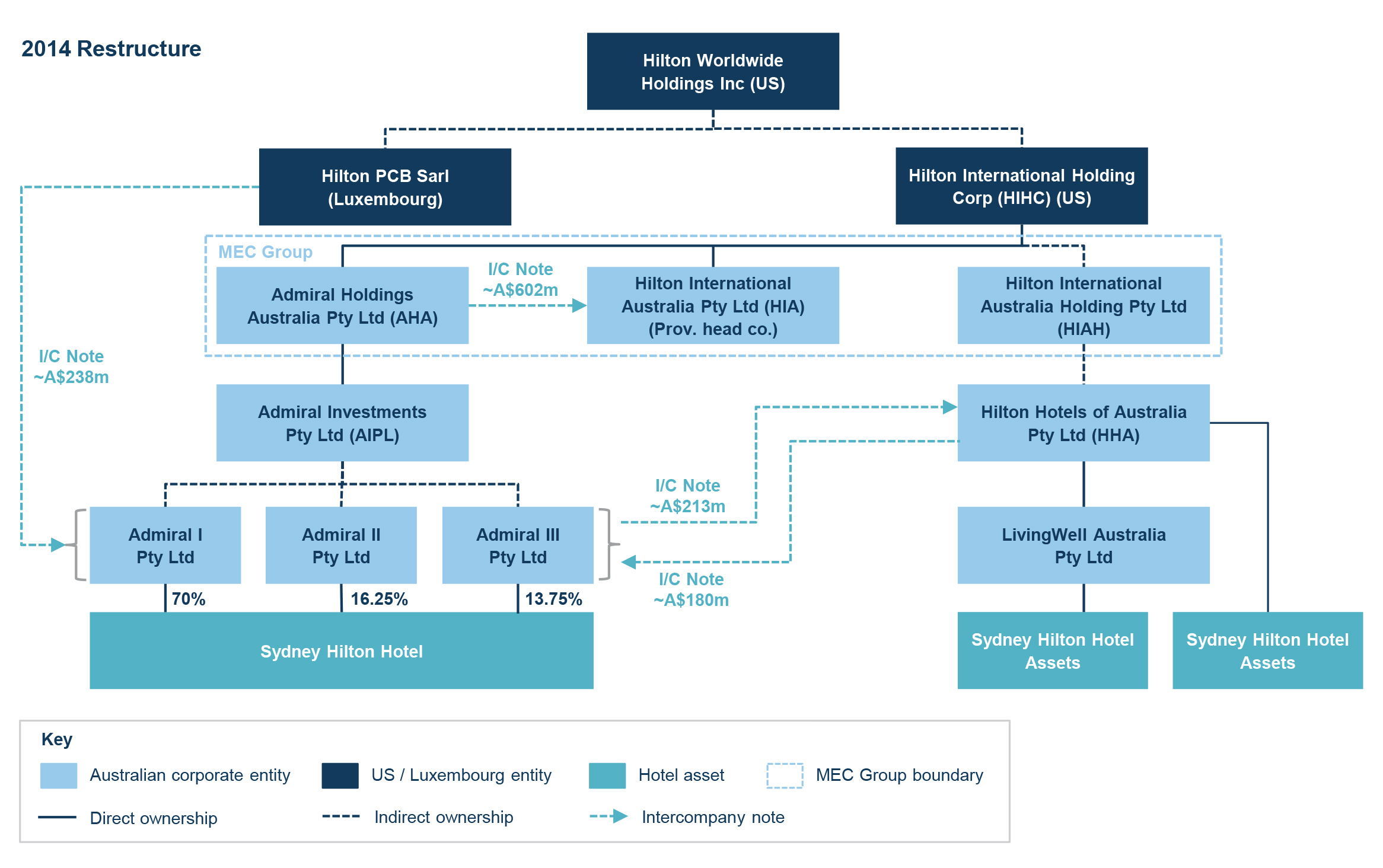
Information sourced from Hilton International Australia Pty Ltd v Commissioner of Taxation (No 2) [2026] FCA 1325
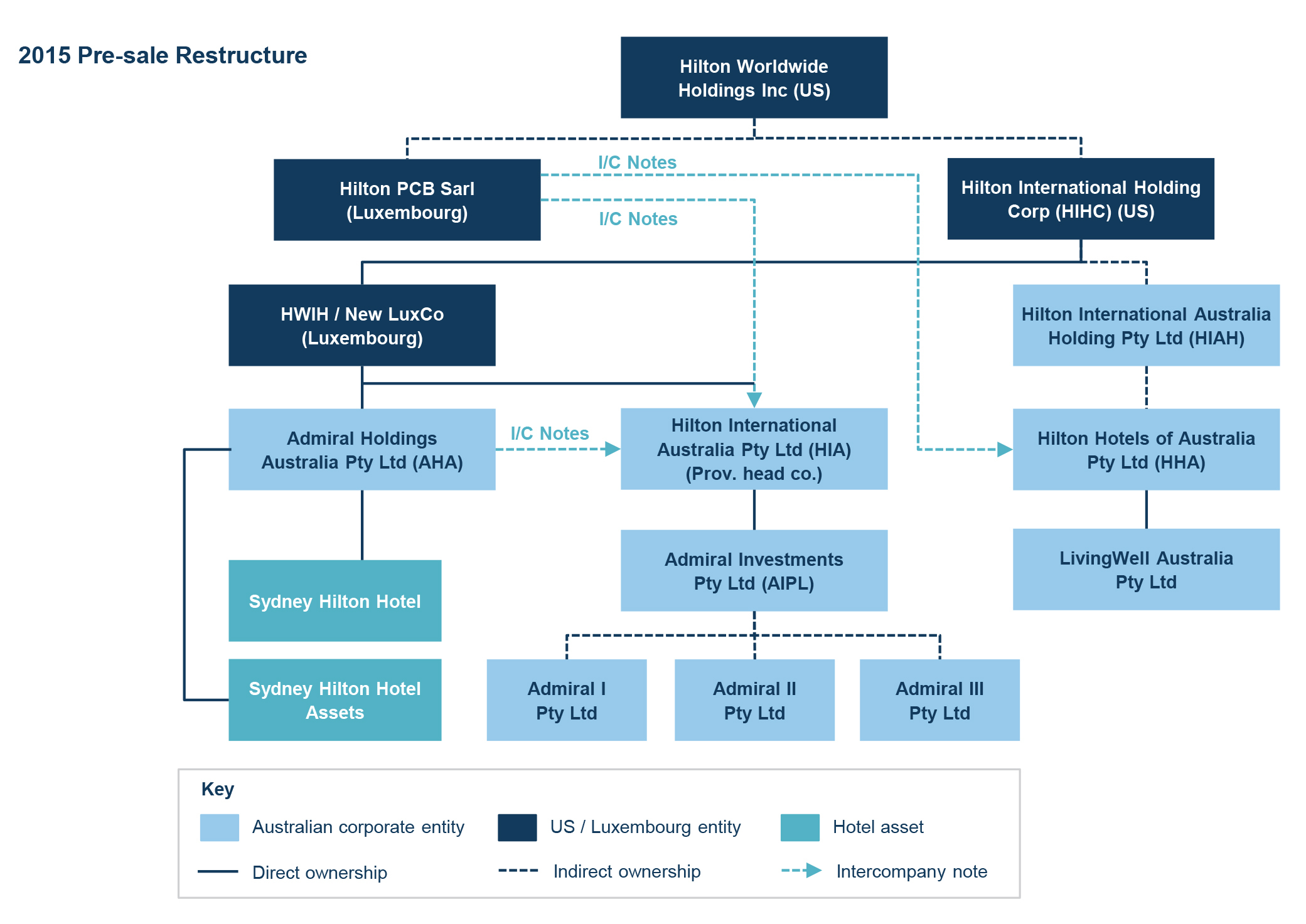
Information sourced from Hilton International Australia Pty Ltd v Commissioner of Taxation (No 2) [2026] FCA 1325
Definition of a scheme: dealing with ‘preparatory’ steps
Younan J accepted that the transactions comprising the ‘Actual Sale’, including the pre-sale restructuring steps, the transfer of the AHA share by HWIH and the repayment of the intercompany note, fell within the broad definition of ‘scheme’ in section 177A(1). Both parties accepted that the Actual Sale met this definition.
The scheme was therefore defined broadly to include the pre-sale restructuring, the share transfer and debt repayment (Scheme), rather than being confined to the final steps of the transaction.
Of particular interest was the Court’s consideration of events occurring both before and after the identified Scheme. Younan J observed that such events, ‘in particular the prior allocation of debt and the subsequent novation of contracts, may be relevant to an assessment of the Scheme relative to the alternative postulates and to ascertain its purpose’. Her Honour did not go as far as to include the preparatory steps as part of the Scheme. However, that did not impact on the outcome as the debt allocation and contract novation clearly coloured the Scheme and her subsequent analysis.
Hilton Group had considered selling the Hotel as early as 2012. The allocation of debt to AHA occurred in 2014 against that background. The Court found an ‘inextricable link’ between these historical events and the later Scheme and treated that history as relevant to the section 177D(2) purpose inquiry. The Court also had regard to the activity of Bright Ruby following completion. This included the transfer of the Hotel’s assets to a trust on 28 July 2015, subsequent winding up of AHA, and ultimately the sale of the Hotel by way of an asset sale in 2022.
This broader temporal approach is significant. Where a scheme is defined broadly, as in Hilton, there may be a wider range of potential alternative postulates. Conversely, as illustrated by PepsiCo, where the scheme is defined more narrowly, identifying an appropriate alternative postulate may be more difficult.
The case therefore highlights the importance of carefully identifying the scheme at the outset, as the scope of the identified scheme defines the transaction against which the proposed alternative postulate must be assessed. It also highlights that the inquiry may go beyond the defined Scheme to take account of a wider scheme where elements are relevant to analysis of the Scheme.
How closely must the alternative correspond to the scheme?
Younan J considered that section 177CB(4) does not require an alternative postulate to replicate the precise substance or outcome of the scheme, provided its commercial and economic substance generally accords with it. This is consistent with the approach adopted by the High Court in PepsiCo at [95], which emphasised that a reasonable alternative postulate should generally accord with, rather than replicate, the commercial and economic substance of the scheme it replaces. Further, Younan J rejected HIA’s attempt to derive from PepsiCo a narrower ‘same substance’ principle (meaning that the alternatives would be limited to a share sale scenario), holding that such an approach reflected the particular facts of that case rather than a general rule of statutory construction.
This approach is consistent with the ATO’s position in its Decision Impact Statement on PepsiCo (DIS). The ATO asserts (DIS at [73]) that section 177CB(4)(a) does not require a postulate to reproduce or replicate the substance or consequences of the scheme. It said replication would ‘neuter Part IVA’, because a postulate that replicates a scheme’s substance and consequences would also replicate its tax effects, precluding identification of any tax benefit. The divergence between Hilton, PepsiCo and Hicks is therefore not about whether replication is required – all three accept it is not – but about how broadly or narrowly the substance of the scheme is characterised, and what that means for the range of available postulates.
In PepsiCo, the substance of the scheme was that no royalty was payable; a postulate that introduced one was therefore misaligned with that substance and unreasonable (DIS at [72]). In Hicks, the taxpayer identified a postulate that accorded with the substance of the scheme and produced no tax benefit, which was sufficient to discharge its onus.
In Hilton, Younan J characterised the substance of the scheme at [132] as the sale of the Hotel and its business assets for substantial value in a strong market, with long-term management rights retained. It expressly rejected the submission that the legal form of the sale – a share sale rather than an asset sale – was itself a necessary part of that substance. Because that commercial substance was achievable by multiple conventional structures, section 177CB(4)(a)(i) did not constrain the Commissioner’s available alternatives (Hilton at [95]–[98], [317]). It followed that an asset sale (AP1) generally accorded with the commercial and economic substance of the scheme and was accepted as a reasonable alternative postulate (Hilton at [159]).
Once the substance of the scheme is characterised broadly enough to admit multiple reasonable alternatives, a further question arises about the Court’s role in resolving them. Where multiple postulates are available, should the Court select the postulate producing the greatest tax benefit, or must it instead determine which is the most reasonable in the circumstances, given the express statutory words of ‘a reasonable alternative’? Notably, in Mylan Australia Holding Pty Ltd v Commissioner of Taxation (No 2) [2024] FCA 253 (Mylan), the Court went further and formulated its own preferred counterfactual departing from both parties’ experts. This illustrated the significant latitude courts retain in this analysis and reinforced the practical unpredictability of the postulate inquiry.
Younan J based her approach on the fact that ‘a’ reasonable alternative invited a wider inquiry than would have been available if the words were ‘the reasonable alternative’. As outlined below, this is aligned with the ATO view, which finds some support in PepsiCo but may conflict with Hicks. If there is an appeal, this will likely be an issue.
Development of the counterfactual
The judgment raises several questions about how the counterfactual, or alternative postulate, should be developed and tested against the scheme. Each of these questions is considered below.
What does section 177CB require?
Section 177CB(3) provides that ‘[a] decision that a tax effect might reasonably be expected to have occurred if the scheme had not been entered into or carried out must be based on a postulate that is a reasonable alternative to entering into or carrying out the scheme’. Section 177CB(4) requires particular regard to be had to the substance of the scheme and any result or consequence for the taxpayer achieved by the scheme, while disregarding any result under the ITAA 1936 that would be achieved by the postulate for any person.
This ‘reconstruction approach’ directs attention to what would, or might reasonably be expected to, have happened absent the scheme, assessed by reference to the commercial and economic substance of the scheme rather than its legal form. The onus rests on the taxpayer to prove that it did not obtain a tax benefit: PepsiCo at [205]; Hilton at [81].
In Hicks, the Full Federal Court held that the Court’s task under section 177CB is to find what might reasonably be expected to have happened based on the ‘facts, circumstances and totality of the evidence’, rather than to choose between the parties’ competing postulates. Applying that approach, the Full Court accepted that the taxpayers had demonstrated a reasonable alternative. This was a transfer of the CBT units for shares and a receivable, with the receivable subsequently assigned to the Division 7A creditors, under which no amount would have been included in the taxpayers’ assessable income. Having accepted the taxpayers’ alternative postulate, the Court considered it unnecessary to resolve whether the Commissioner’s competing alternative was itself reasonable.
The ATO’s Decision Impact Statement on PepsiCo goes further, stating at paragraph 70 that ‘it is our view that PepsiCo at [207] raises the possibility that there can be more than one alternative postulate that is reasonable, contrary to the position for Part IVA prior to the 2013 amendments’. It also said at paragraph 71 that ‘a taxpayer does not discharge its onus merely by demonstrating that there is one reasonable alternative that does not result in the obtaining of a tax benefit’. This position sits uneasily with the Full Federal Court’s approach in Hicks, which proceeded on the basis that, once a reasonable alternative was established by the taxpayer, it was unnecessary to weigh it against any alternative advanced by the Commissioner. The High Court refused special leave to appeal Hicks on 9 April 2026, so the Full Federal Court’s single-postulate approach stands as settled authority. Hilton cannot be reconciled with that approach without a Full Court appeal from the present decision.
What happens when the taxpayer’s counterfactual is not reasonable?
Where the taxpayer cannot establish a sufficiently persuasive alternative, it appears that the Commissioner might be allowed to advance numerous reasonable postulates, creating a significant practical risk for taxpayers. As a practical matter, the ATO will likely always (and typically does) put more than one option on the table. The key issue is how the Court analyses those options and ultimately how it selects one or more options from them. Ultimately, the Court may even adopt an alternative of its own design.
As the Full Federal Court explained in RCI Pty Ltd v Commissioner of Taxation:
‘[e]ven if a taxpayer establishes that the Commissioner’s counterfactual is unreasonable, it will not necessarily follow that the taxpayer has established that the assessment is excessive. That is because the issue is not whether the Commissioner puts forward a reasonable counterfactual or not; it is a question of the court determining objectively, and on all of the evidence… what would have or might reasonably be expected to have occurred if the scheme had not been entered into.’
That reasoning was endorsed by the High Court in PepsiCo and applied by Younan J in Hilton. Taxpayers may therefore need to test their position against each reasonably arguable alternative, rather than assuming that a single counterfactual will determine the tax benefit. The limit seemingly arising out of Hicks becomes critical in this scenario and is likely to be relitigated by the ATO.
The practical consequence is important. Where multiple alternatives are found to be reasonable, the taxpayer may not necessarily discharge its burden simply by identifying one reasonable alternative that produces no tax benefit. Hilton suggests that a taxpayer may be required to defend not only its own postulate but also those raised by the Commissioner that the Court ultimately finds to be reasonable.
Does the Court need to choose one from the ATO’s shopping list?
Where multiple postulates are advanced by the Commissioner, a related question is whether the Court must select the postulate producing the greatest tax benefit, or whether it must instead assess which is the most reasonable in the circumstances. There is no clear statutory basis for simply choosing the alternative that produces the highest tax benefit.
Younan J addressed this question directly, concluding that the correct construction is that:
‘the Court is to look at all of the alternative postulates proposed by parties and ask whether one or more is “reasonable”. Of the alternatives determined to be “reasonable”, the Court then considers whether the taxpayer’s income would have been higher under each alternative. If the taxpayer’s income would have been higher under more than one alternative, then the highest point indicates the extent of the disparity between the scheme and “a reasonable alternative”, and therefore the extent of the tax benefit in relation to the scheme.’
Her Honour observed that this approach is supported by the statutory language in section 177CB(3), which refers to ‘a reasonable alternative’ rather than ‘the reasonable alternative’. This indicates that Parliament contemplated the possibility of more than one reasonable postulate, but did not go on to provide a statutory basis for selecting the alternative that produced the highest tax benefit.
Is a counterfactual disqualified because it may be a Part IVA scheme?
HIA proposed a debt-free sale of AHA AP3. Under this, the intercompany debt would effectively have been replaced by share capital before the sale. HIA relied on AP3 as the most reliable prediction of what would have happened in the absence of the Actual Sale.
The Court rejected AP3 on the basis that it was itself a Part IVA scheme. Younan J characterised AP3 and the Actual Sale as ‘two sides of the same coin’. It drew on the line of authority including Futuris Corporation Ltd v Federal Commissioner of Taxation and Hart v Commissioner of Taxation, which establishes that a postulate cannot serve as a reasonable alternative where it is itself infected by a dominant tax-avoidance purpose. The principal difference between AP3 and the Scheme was that, under AP3, the debt would be replaced with share capital before the sale, increasing the cost base and altering where the resulting gain would arise.
Younan J explained that the comparative exercise required by section 177C(1)(a) ‘cannot be undertaken if the foil reflects the scheme, including its purpose’, because ‘it is paradoxical to assume that the scheme had not been entered into or carried out on the basis that another scheme had been entered into or carried out’.
Using a Part IVA scheme as the comparator would therefore undermine the statutory task of identifying the tax benefit that might reasonably be expected to have arisen in the absence of the scheme. This would lead to a potentially circular inquiry in which the tax consequences of one scheme are measured against another.
Consistent with Hart, the onus fell on HIA to demonstrate that AP3 would not itself have been subject to Part IVA, an onus which the Court found it had not discharged.
What is the relevance of the quantum of the tax benefit?
The Court found that the A$173 million tax benefit was significant, but the quantum of the benefit, considered in isolation, said little about the taxpayer’s purpose.
Interestingly, while the quantum of the tax benefit, considered alone, does not determine the taxpayer’s purpose, the Court nonetheless accepted the postulate producing the highest tax benefit as relevant to measuring the extent of the tax benefit under section 177CB(3).
How do you reconcile all of this with the decision in Hicks?
In Hicks, the Full Federal Court considered a selective share capital reduction used to facilitate repayment of approximately A$52 million of Division 7A loans. The Court accepted the taxpayers’ evidence that, absent the scheme, the CBT unitholders would have transferred their units to Methuselah in exchange for shares and a receivable. This would then have been assigned to the Division 7A creditors, under which no amount would have been included in the taxpayers’ assessable income.
Hicks proceeded on the basis that, once the taxpayer established the alternative reasonably expected to have occurred, it was unnecessary to resolve the Commissioner’s competing alternative. Hilton, by contrast, contemplates that multiple reasonable alternatives may be considered, with the highest resulting tax benefit potentially determining the extent of the benefit.
This apparent tension may be an important issue on any appeal from Hilton, particularly in relation to the proper application of section 177CB(3). If Hicks requires the identification of a single ‘correct’ alternative postulate, Hilton adopts a materially different approach. Notably, special leave to appeal the Hicks decision was refused by the High Court on 9 April 2026, meaning the Full Federal Court’s single-postulate approach in Hicks is settled authority. The tension between Hilton and Hicks can therefore only be resolved through a Full Court appeal from the present decision, making any appeal from Hilton particularly significant.
What is the relevance of the buyer’s subsequent actions?
The Court also considered evidence that the purchaser regarded AHA’s debt structure as unusual and raised concerns about it. Following completion, the purchaser transferred the Hotel assets to a trust and ultimately wound-up AHA. When the Hotel was subsequently sold in 2022, it was sold by way of an asset sale.
Younan J’s consideration of these post-transaction events raises an important question as to the extent to which a Court may have regard to events occurring after the relevant transaction when assessing whether an alternative postulate was reasonable.
Pre-transaction events may more readily inform the assessment of what was reasonably available to the taxpayer at the relevant time. By contrast, relying on the subsequent conduct of an unrelated third party, after the taxpayer’s dealings had concluded, may introduce an element of hindsight into the analysis. This is particularly so where that third party was operating under different commercial considerations. As a matter of practical reality, evidence of the purchaser’s preferred acquisition structure can either undermine or support the vendor’s assertions as to the commerciality of pre-transaction structuring where such structuring is said to be undertaken for the benefit of the vendor.
It remains to be seen how far this reasoning will extend in future cases, and whether the Full Federal Court would endorse it in its entirety. This may be particularly relevant where subsequent events are relied upon to assess whether an alternative postulate was commercially realistic at the time the scheme was entered into.
In the context of a deal: documenting and evidencing the counterfactual and commercial purpose
A recurring theme in the judgment was the Hotel’s status as a ‘trophy asset' in a seller’s market. The Court accepted that the Hotel’s desirability gave Hilton Group significant bargaining power, and that bargaining power meant that the particular sale vehicle was not shown to be necessary to achieve the stated commercial objectives. Notably, the Investment Committee memorandum recommending the sale structure stated that it represented ‘an excellent opportunity to exit an owned asset in a tax-efficient manner’ and confirmed that the structure had been adopted ‘for tax reasons’ (at [321]).
The judgment illustrates the importance of distinguishing between a commercial objective and the mechanism said to be necessary to achieve it. Evidence that the objective was genuinely important does not necessarily establish that the chosen tax-sensitive structure was required to achieve it. The Court found that the absence of HIA’s professed commercial rationale from contemporaneous documents, and in particular from the Investment Committee memorandum itself, undermined that rationale (at [322]).
HIA’s hotel management agreement argument fared no better. HIA placed substantial weight on the submission that the transaction structure was needed to preserve favourable hotel management agreement terms. It relied on an asserted ‘embedding’ strategy said to reduce the purchaser’s scope to renegotiate those terms. The Court found that this strategy was not supported by contemporaneous documents. Expert evidence established that similar management arrangements could have been achieved under an asset sale. The comparable sale of the Sheraton on the Park hotel, structured as an asset sale with a long-term management agreement on broadly similar terms, provided a useful market comparator that undermined HIA’s position.
The decision also reinforces the importance of contemporaneous evidence. Where a taxpayer later relies on a particular commercial rationale, the absence of contemporaneous documents supporting that rationale can be significant. Conversely, clear records of commercial objectives, alternatives considered, transaction constraints and decision-making can assist in demonstrating that a transaction structure was selected for genuine commercial reasons.
The decision also diverges from Mylan on the documentary silence point. In Mylan, the absence of particular documents was not treated as affirmative evidence against the taxpayer. A commercial rationale was accepted without demanding granular documentary proof of each stated driver. Younan J’s approach in Hilton is more demanding: where a contemporaneous document positively records a tax rationale and other documents are silent on the asserted commercial rationale, the Court drew an adverse inference, ‘an objective not stated – particularly one now stated to be of central importance – is an objective not held’ (Hilton at [322]). The distinction matters. The adverse-inference approach in Hilton rested on a particularly damaging Investment Committee memorandum, not on silence alone, and Hilton should not be read as establishing a general rule that documentary silence is likely to be fatal.
Transaction teams should ensure that the commercial rationale for a transaction and its chosen structure is appropriately documented as part of the transaction process. Board papers, investment committee materials, adviser correspondence and negotiation records may provide useful evidence of the commercial objectives being pursued, the reasons for selecting a particular structure and the alternatives considered.
Where Part IVA risk is material, it may also be useful to consider, at an early stage, what alternative arrangements might realistically have been available to the taxpayer. Evidence of market practice, comparable transactions and the parties’ respective bargaining positions may assist in assessing the commercial realism of those alternatives.
When the ATO disputes a position – next steps
Where the Commissioner disputes a taxpayer’s position under Part IVA, Hilton suggests several practical steps. A taxpayer may be required to defend its own alternative postulate, and also the postulates raised by the Commissioner that are found to be reasonable. This is rather than assuming that identifying a single reasonable alternative will be sufficient to discharge its burden. This highlights the evidentiary burden and importance of balancing asserted positions throughout the dispute lifecycle.
Taxpayers should also test their proposed counterfactual, and any likely Commissioner alternatives, as early as possible, and ensure that their own counterfactual is itself capable of withstanding Part IVA scrutiny. A postulate that is itself a Part IVA scheme, as with AP3 in Hilton, will not be an appropriate comparator.
Hilton may also be appealed given the tension with Hicks. The Full Court may need to consider the proper application of section 177CB, including whether a tax benefit must be measured against a single reasonable alternative or may be measured against the most favourable of several reasonable alternatives.
Is there a ‘rebuttable presumption’ of a natural counterfactual for a property transaction?
For property transactions, there may be a natural or default transaction structure that serves as the starting point for the counterfactual analysis, as illustrated by the alternative postulates considered in Hilton.
Dealing with the whole assets – asset sale
HIA argued that AP1 would have been materially more complex. This is because it would involve multiple vendors, extensive due diligence, the novation of supplier agreements and leases, and greater risk to the hotel management arrangements. The Court was not persuaded.
The Court noted that the Actual Sale itself involved significant asset-level due diligence as part of the preceding internal restructures. The accepted evidence also established that asset sales were market practice for hotels in Australia at the relevant time. The contemporaneous example of the Sheraton on the Park transaction, which involved an asset sale and a long-term hotel management agreement, further supported the Commissioner’s position.
Importantly, the Commissioner’s expert evidence was that Hilton Group’s position as the seller of a highly desirable hotel in a seller’s market meant that it could have achieved substantially the same commercial outcome under an asset sale. AP1 was therefore reasonable.
This suggests that, for property transactions, an asset sale may be the natural starting counterfactual.
Exiting some unitholders – entity level
Where a share sale is used instead, the Court considered alternatives including a sale through an existing entity and a sale through a newly incorporated vehicle. AP2 involved selling the Hotel through an existing entity with a substantial history and a number of underlying entities and potential tax sharing liabilities. The Court accepted that this entity was less attractive than a newly incorporated sale vehicle. However, it held that this was not enough to make the postulate unreasonable, emphasising that an alternative does not have to be the most reasonable alternative to satisfy the statutory test.
AP4 involved incorporating a new entity and transferring the Hotel and relevant business assets into it before the sale. Unlike AHA, the new entity would have had no trading history, no substantial intercompany debt and no potential legacy tax sharing liabilities. The Court accepted that due diligence on such an entity would have been comparatively straightforward, and accepted AP4 not merely as reasonable but as the most reasonable alternative.
The distinction matters where the transaction involves exiting equity holders at the entity level, rather than selling the underlying asset.
What type of features might attract Part IVA in a property transaction?
The Hilton decision illustrates a number of features that may attract the application of Part IVA in a property transaction. This includes related-party restructuring, a departure from established market practice, a disparity between the legal form of a transaction and its commercial substance, the allocation of value between shares and debt, the use of special-purpose entities, and the absence of contemporaneous evidence of commercial rationale.
The Hilton facts illustrate how these features interact under the section 177D(2) factors:
- On the manner factor, the selection of AHA as the sale vehicle, together with its substantial intra-group debt, was not shown to provide a corresponding commercial benefit to Hilton Group.
- On the form and substance factor, the Court identified a disparity between the legal form of the transaction, a share sale for consideration of approximately A$29 million coupled with the repayment of approximately A$420 million of intercompany debt, and its commercial substance, being the sale of the Hotel for a good price with a long-term management agreement.
- On the connection factor, all of the relevant entities were within the Hilton Group, which heightened the need for a persuasive commercial explanation for the chosen structure.
Transactions involving related-party dealings, departures from established market practice or significant differences between form and substance may therefore expose taxpayers to multiple reasonable postulates being identified by the Commissioner.
Significance of Hilton as a Part IVA decision
Hilton is a significant Part IVA decision because it demonstrates how the alternative postulate analysis can operate where a complex related-party restructuring produces a substantial tax benefit. The decision suggests that multiple reasonable alternatives may be identified. It also suggests that a taxpayer’s proposed alternative may itself be excluded where it bears the characteristics of a Part IVA scheme. At the same time, the apparent tension between Hilton and the Full Federal Court’s approach in Hicks on the proper application of section 177CB may be tested on appeal. Practitioners should closely monitor how the law develops in this area.
For corporate taxpayers, the key takeaway is that the analysis is as much evidentiary as it is doctrinal. In transactions involving intra-group restructurings, debt allocation or special-purpose entities ahead of a sale, contemporaneous evidence of the commercial rationale for the steps taken may be important in assessing Part IVA risk. Contemporaneous evidence that the structure was directed to genuine commercial objectives, and that alternative approaches were considered in light of those objectives, may assist the taxpayer in responding to a subsequent Part IVA inquiry.
Taxpayers should, however, be cautious about treating PepsiCo as establishing a general safe harbour. The circumstances in that case, including the arm’s length, market-standard nature of the transaction between unrelated parties, were important to the Court’s analysis. They are materially different from the related-party restructuring considered in Hilton. The extent to which the reasoning in PepsiCo applies will therefore depend on the particular facts and commercial context of each transaction.
Stand by for the potential appeal.
Findings on evidence
Key evidence issue | Younan J's findings | Possible inconsistencies with other Part IVA cases |
|---|---|---|
Mr Enayetullah's opinion evidence |
|
|
Expert preference: Mr Harper (Commissioner) over Mr Dransfield (HIA) |
|
|
Multiple reasonable alternative postulates permitted (s 177CB(3)) |
|
|
Alternative postulate rejected as itself a Part IVA scheme (AP3) |
|
|
Contemporaneous documents preferred over oral testimony; documentary silence = adverse inference |
|
|
Pre-scheme events (2014 restructure) relevant to s 177D dominant purpose |
|
|
Internal tax communications treated as objective evidence of purpose |
|
|
‘Seller's market’ finding used to validate alternatives, not the scheme |
|
|
Authors
Head of Tax
Consultant
Partner
Head of Tax Controversy
Senior Associate
Tags
This publication is introductory in nature. Its content is current at the date of publication. It does not constitute legal advice and should not be relied upon as such. You should always obtain legal advice based on your specific circumstances before taking any action relating to matters covered by this publication. Some information may have been obtained from external sources, and we cannot guarantee the accuracy or currency of any such information.
Key Contact

Other Contacts